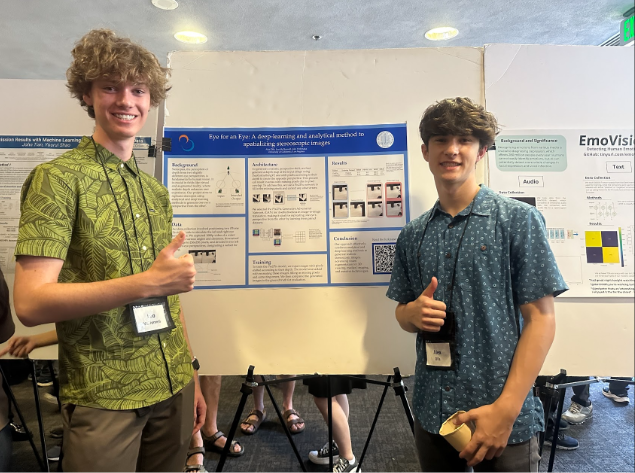
Eye For An Eye: A Deep-Learning and Analytical Method to Spatializing Stereoscopic Images

Turning a single left-eye image into an offset right-eye view with depth-aware image translation.

Jake Yoshinaka, Alex Dils, Leo McDonnell
Published in NHSJS on April 17, 2025

The final pipeline uses an analytical depth-and-shift preprocessing step, fills blank pixels with interpolation, then trains Pix2Pix to synthesize the offset view.

Abstract

This project studies stereopsis-inspired image transformation: given a scene from one viewpoint, generate the corresponding image from a slightly offset viewpoint. The work compares a Pix2Pix-only image translation model, a hybrid method that combines monocular depth estimation with analytical pixel shifting before Pix2Pix, and a final variant that adds interpolation to repair blank regions introduced by the shift.

The interpolation-enhanced hybrid model performs best in the article's evaluation, reaching SSIM 0.81 and PSNR 20.6 dB on the held-out test set. The result supports a practical design principle: analytical depth cues can make the learned perspective transform easier, while the generator handles visual reconstruction and local realism.

Method

Three approaches to monocular-to-stereo transformation

1. Pix2Pix baseline

A conditional GAN learns direct image-to-image translation from the left-eye frame to the right-eye target.

2. Depth-and-shift hybrid

Depth Anything v2 generates a relative depth map, and pixels are shifted horizontally according to the estimated depth before Pix2Pix training.

3. Interpolation enhanced

Blank regions left by the depth shift are filled before the image is passed to Pix2Pix, reducing reconstruction artifacts.

Dataset

Paired stereo frames collected from two phones

The dataset was collected with two identical iPhone 12s placed 75 mm apart to mimic eye separation. Videos were recorded at 30 fps, then converted into 3,960 paired frames with each left-eye image matched to a ground-truth right-eye image. Frames were cropped to 512 × 512 and split into training, validation, and testing partitions.

3,960 paired left/right frames
75 mm camera separation
512 pixel crop size per side

Results

Interpolation-enhanced hybrid model performed best

0.81 SSIM for Model 3
20.6 PSNR in dB
10.3 MAE on the test set
Model Training input SSIM PSNR MSE MAE
Pix2PixOriginal0.7219.9689.911.9
CompositeCombined0.7620.3630.911.0
Model 3 BestEnhanced0.8120.6628.010.3

Figures

Eye For An Eye project poster presentation
Poster presentation for Eye For An Eye.
Inference process comparison for three stereoscopic image models
Comparison of the Pix2Pix baseline, depth-and-shift hybrid, and interpolation-enhanced model.
Generated right-eye image compared with true right-eye image
Example generated right-eye view compared with the true right-eye target.

Availability

Published article and PDF

Research area

Stereoscopic view synthesis, monocular depth estimation, and image-to-image translation.